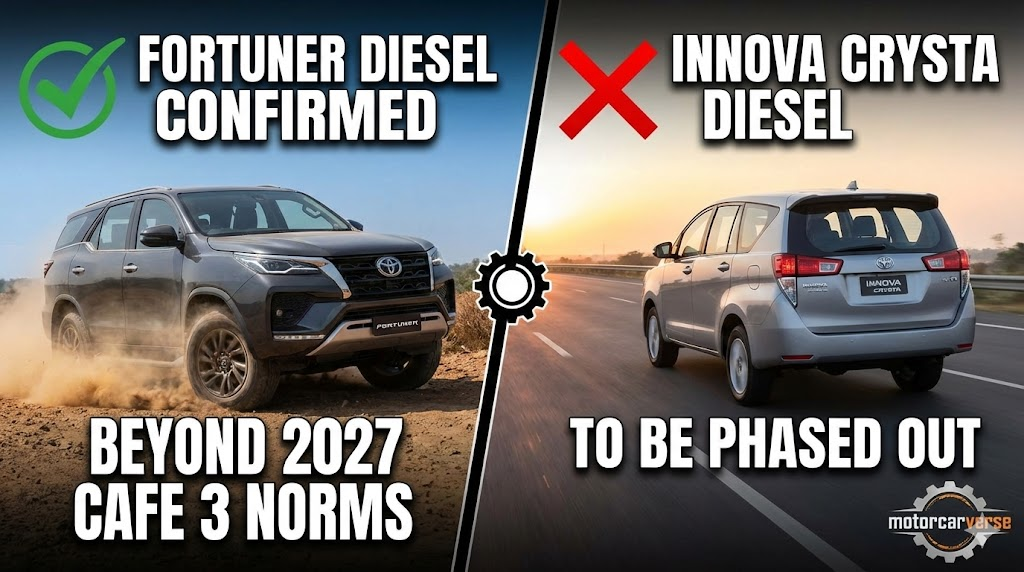
Toyota Kirloskar Motor (TKM) has confirmed that its popular Fortuner SUV and Hilux pickup will retain their diesel engine options beyond 2027, successfully navigating the upcoming Corporate Average Fuel Efficiency (CAFE) 3 norms. Conversely, the diesel variant of the Toyota Innova Crysta is slated for discontinuation next year, ahead of the new regulations taking effect from April 2027.
Engine Lineup Adjustments
The robust 2.8-liter diesel engine, central to the Fortuner and Hilux, is set to continue powering these models. This four-cylinder, inline DOHC unit delivers 204 PS of maximum power, paired with 420 Nm of peak torque with a manual gearbox, increasing to 500 Nm when mated to an automatic transmission. Additionally, the 2.8-liter turbo diesel engine is also offered with a 48V mild-hybrid system, incorporating an integrated starter generator (ISG), a 48V lithium-ion battery, and regenerative braking. In contrast, the Innova Crysta will cease to offer its 2.4-liter diesel powertrain.
Addressing Market Demand and CAFE 3 Compliance
Speaking to media, Sabari Manohar, Executive Vice President, Sales and Service at Toyota Kirloskar Motor, highlighted the consistent strong demand for larger diesel SUVs like the Fortuner. Manohar commented on the specific market segments, stating, “There are hardcore fans for diesel,” and acknowledged that for vehicles like the Crysta, “it’s a purely diesel segment.” He further noted TKM’s current focus on meeting diverse consumer preferences, observing, “At this point in time, we have good demand for hybrids, good demand for ICE, and we hope to create a good demand for EV as well.” Manohar also added, “We need to see how the whole policy direction changes.”
The impending CAFE 3 norms, effective from April 2027, will introduce more stringent fuel efficiency standards, targeting an average CO2 emission of approximately 91-93 g/km. Compliance will necessitate significant investment from original equipment manufacturers (OEMs) in advanced technologies, including upgraded valve systems, idle-stop functionalities, hybrid powertrains, and lightweight materials. These changes are anticipated to impact the pricing of smaller internal combustion engine vehicles, while potentially accelerating the adoption of strong hybrids and electric vehicles.