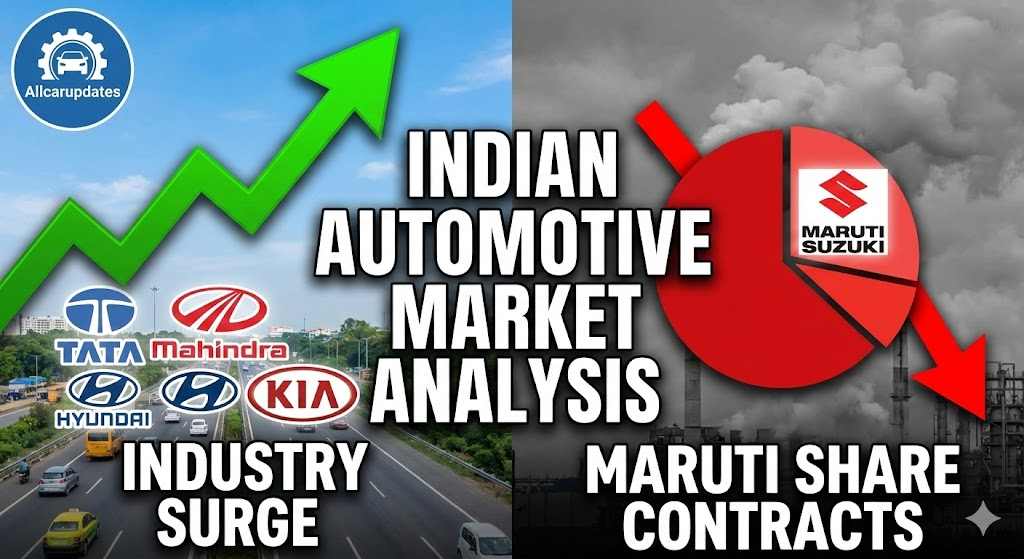
The Indian automotive landscape is undergoing a significant structural shift as Maruti Suzuki, the nation’s largest manufacturer, faces a narrowing lead despite achieving record production figures. While the company reported a 37% increase in sales volume since 2021, its total market share has receded from 44.91% to 39.91% as of 2025. This 5% contraction highlights a broader trend where the industry at large is expanding faster than its primary incumbent.
The Growth Paradox
Maruti Suzuki’s internal performance metrics remain strong; the company manufactured 22.55 lakh units in 2025 and surpassed 18 lakh units in total sales. However, the emergence of aggressive competition has diluted its market dominance. Several key manufacturers have reported triple-digit or high double-digit growth rates over the last four years, outpacing the market leader’s expansion.
- Mahindra: Registered a 193% increase in sales volume since 2021.
- Toyota: Documented a 145% surge in sales performance.
- Tata Motors: Recorded a 71% growth in unit sales.
- Secondary Players: Skoda, Volkswagen, and MG have also secured higher market shares compared to their 2021 standings.
Conversely, while Hyundai and Kia maintained healthy sales growth, both brands saw a slight decline in their overall market share. Manufacturers such as Nissan, Renault, and Jeep faced more significant challenges, reporting simultaneous drops in both sales volume and market percentage.
Segment Specialization and Market Gaps
Maruti Suzuki’s current strategy remains heavily anchored in the sub-four-meter segment. By focusing on petrol engines under 1,200cc, the brand capitalizes on a lower 18% tax bracket, avoiding the 40% tax applied to larger vehicles. This focus on hatchbacks and the CNG sector has sustained high volumes but has left the brand exposed in other high-growth areas.
Currently, Diesel and Electric Vehicles (EVs) represent 20.7% of total passenger vehicle sales in India. Maruti Suzuki’s absence from these segments has allowed competitors to gain ground. Tata Motors and MG have established a firm foothold in the EV market, while Mahindra and Hyundai continue to lead in diesel powertrains. The rise of the SUV segment, driven by models like the Tata Nexon, Tata Punch, Mahindra XUV700, and Mahindra Scorpio, has been a pivotal factor in shifting consumer interest away from the traditional small cars that form Maruti’s core portfolio.
Future Market Outlook
The data indicates that the Indian automotive industry is entering a more competitive era characterized by diversified consumer preferences. As the market continues to grow at an accelerated rate, the distribution of market share is becoming more balanced. Should current trends persist, the industry may move away from the historical dominance of a single manufacturer toward a landscape where multiple players hold more equitable portions of the market.